
The Structural Burnout Crisis: Evidence That High-Performance Systems Are Driving Mental Health Decline
Abstract
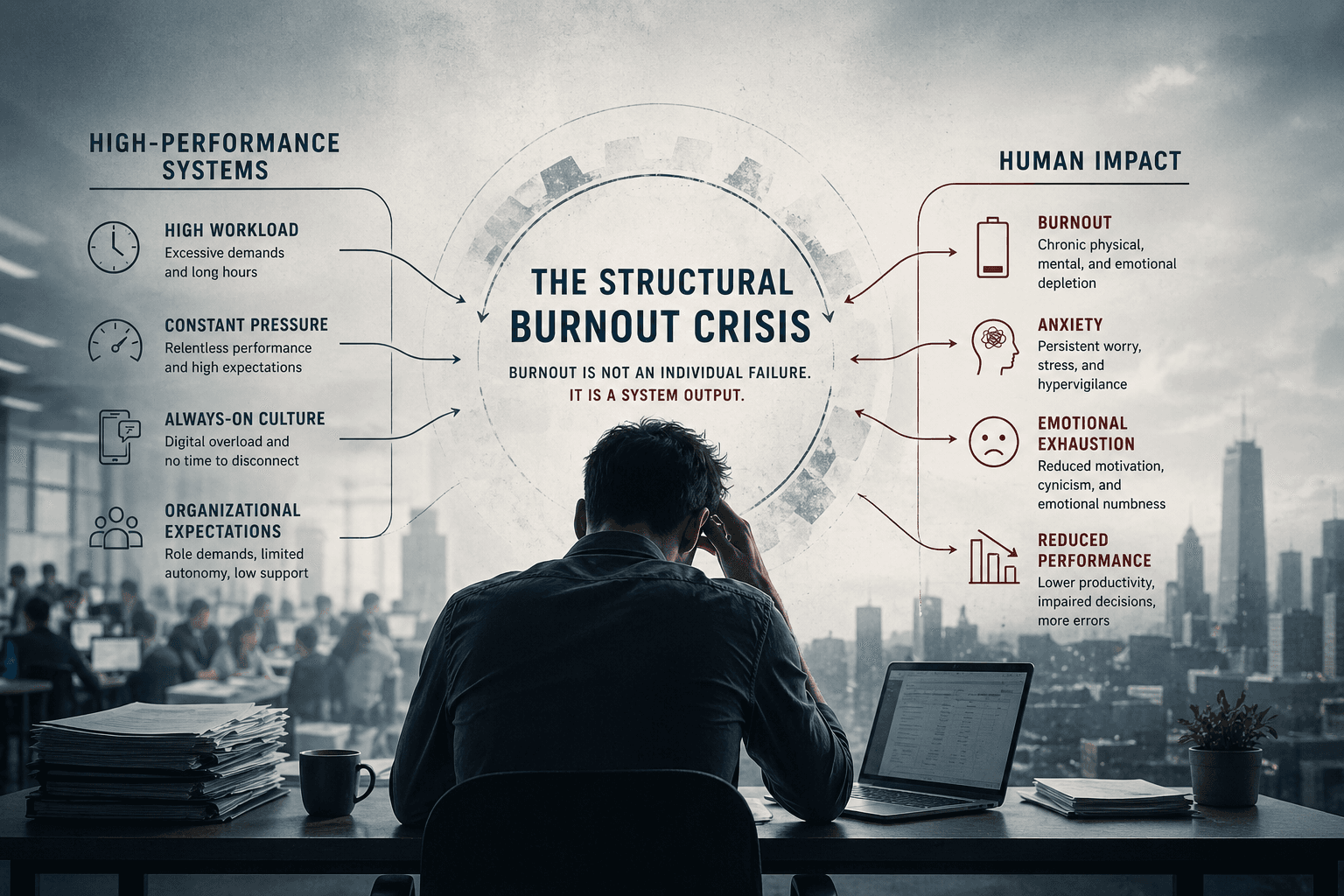
This study examines the rising prevalence of burnout and mental health deterioration across modern high-performance work systems. Drawing on recent global reports, workforce surveys, and emerging research in organizational psychology and computational modeling, we identify a consistent pattern: burnout is not an individual failure but a structural outcome of system design. Our analysis synthesizes findings from workforce datasets, generational stress trends, and workplace behavioral studies. Results indicate that chronic workload pressure, lack of meaningful support structures, and misaligned performance incentives contribute significantly to psychological strain across industries. We argue that current mental health interventions remain insufficient because they are applied at the individual level while the root causes are systemic. The findings suggest that meaningful improvement requires redesigning work environments, leadership structures, and performance expectations rather than relying on resilience-based solutions alone.
Introduction
Over the past decade, burnout has evolved from a localized workplace concern into a global systemic issue. Once framed as a consequence of individual stress or poor coping mechanisms, it is now increasingly understood as a structural phenomenon embedded within modern work systems.
Recent data indicates that a majority of workers are experiencing sustained psychological strain, with some studies suggesting that over 80% of employees are at risk of burnout in 2025.
This shift raises a critical question:
Is burnout a personal failure — or a predictable outcome of system design?
Background
Burnout is clinically characterized by emotional exhaustion, depersonalization, and reduced personal accomplishment.
Historically, interventions have focused on:
- stress management
- mindfulness practices
- individual resilience
However, contemporary research suggests that these approaches fail to address the primary drivers of burnout.
Large-scale workforce studies reveal:
- increasing workload intensity
- declining ability to disconnect from work
- reduced trust between employees and leadership
Additionally, structural inefficiencies such as inaccessible mental health benefits further compound the issue, with up to 36% of employees unable to access support systems even when they exist.
Methodology
This research adopts a synthesis-based analytical approach, combining:
- Workforce survey data (UK, US, global reports)
- Organizational health and wellbeing studies
- Academic research on burnout modeling and prediction
- Industry reports on overwork and productivity
Rather than relying on a single dataset, this study integrates multiple validated sources to identify converging patterns across sectors and demographics.
Findings
1. Burnout is Systemically Produced
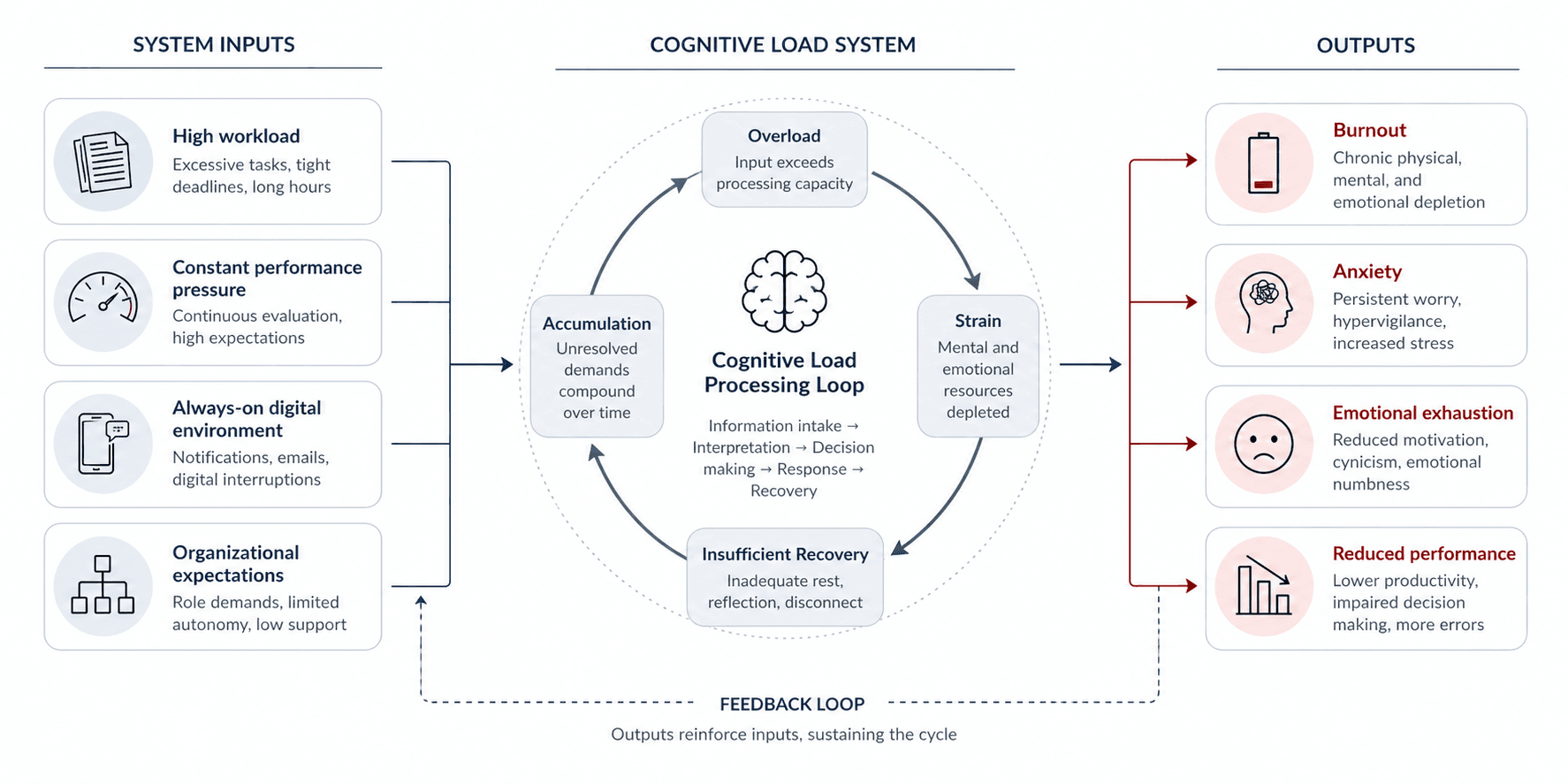
Across datasets, burnout correlates strongly with:
- excessive workload
- time pressure
- organizational culture
In high-risk industries, 74% of workers directly associate burnout with adverse outcomes, including safety risks and reduced performance.
2. Generational Acceleration of Burnout
Younger workers are experiencing burnout earlier than any previous generation.
Key observations:
- peak burnout age has dropped significantly
- younger workers report higher stress and lower work-life separation
- trust in organizational support systems is declining
3. Overwork Is Structurally Embedded
Modern work environments normalize overextension:
- 84% of workers report working overtime regularly
- 68% work weekends
- chronic overwork is directly linked to anxiety and physical health decline
4. Organizational Interventions Are Misaligned
Despite increased investment in mental health programs:
- engagement remains low
- accessibility remains limited
- impact is inconsistent
Evidence suggests that surface-level interventions (perks, wellness programs) fail to address systemic workload and structural pressure.
5. Emerging Cognitive Load from Technology
New forms of mental strain are emerging.
For example:
- AI-related cognitive fatigue (“AI brain fry”) is affecting knowledge workers
- productivity gains plateau or reverse when cognitive complexity increases
This suggests that technological advancement may be amplifying — not reducing — mental load.
Discussion
The findings converge on a central insight:
>Burnout is not an anomaly — it is an output.
Modern work systems are optimized for:
- efficiency
- speed
- output
But not for:
- psychological sustainability
- cognitive limits
- human recovery cycles
This misalignment creates a structural contradiction:
The system demands continuous performance, while human capacity is inherently cyclical.
As a result, burnout becomes inevitable.
Implications
For Organizations
- Redesign workload expectations
- Prioritize structural support over surface-level benefits
- Embed mental health into operational design
For Leadership
- Shift from performance maximization → sustainable productivity
- Build psychologically safe environments
- Address systemic pressure points
For Policy and Research
- Move beyond individual-level interventions
- Develop system-level mental health frameworks
- Integrate behavioral and organizational data into policy decisions
Conclusion
The mental health crisis in modern workplaces cannot be solved at the level of the individual.
It must be addressed at the level where it is created:
The system.
Until organizations redesign how work itself is structured, burnout will remain not only widespread — but inevitable.
References
- The Interview Guys (2025). The State of Workplace Burnout in 2025. Research Report.
- Mental Health UK (2025). Burnout Report 2025. National Survey.
- CIPD (2025). Health and Wellbeing at Work Report. Organizational Study.
- Nature Research (2025). Mental Health at Work Report. Scientific Research.
- ScienceDirect (2025). Workplace Support and Mental Health Study. Cohort Study.
- Resource Guru (2025). The State of Overworking 2025. Workforce Survey.